Welcome!

Please join us to discuss everything literary (especially kid literary): good books, the writing life, the people and businesses who create books, controversies in book world, what's good to snack on while reading and writing, and anything else bookish. We welcome your thoughts.

Friday, August 19, 2011

Monstrumologist: a happy ending?


Poe has learned that Simon & Schuster has reversed its decision (see previous post), and will publish the fourth book in Rick Yancey's MONSTRUMOLOGIST series.

The news was announced on Rick Yancey's Facebook page 16 hours ago.

Poe will append any interesting details, as they become available.

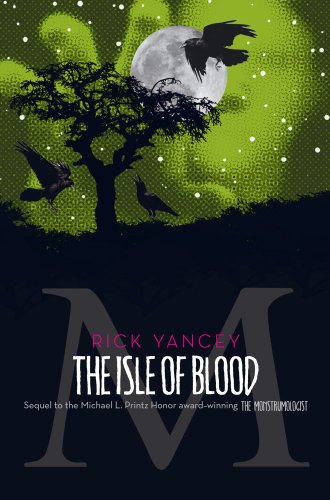
In the meanwhile, Poe exhorts all of you to save your pennies towards the September purchase of book three, THE ISLE OF BLOOD.


Wednesday, August 17, 2011

Monstrumologist: a premature burial?


Poe is shocked and saddened to learn that Simon and Schuster will discontinue Rick Yancey's award-winning MONSTRUMOLOGIST series after the third title, THE ISLE OF BLOOD, comes out next month. When this Blogue chose endings for our August subject, we little thought any publisher would make our theme so sadly relevant.

The reason for the series' demise, according to the author's own reports, is that sales were disappointing.

Poe finds disappointment in another aspect of this end-times tale. The series opener, MONSTRUMOLOGIST, won a 2010 Michael L. Prinz Honor Award for Excellence in Young Adult Literature. The follow-up, THE CURSE OF THE WENDINGO, was a finalist for the Los Angeles Times Book Award.

Does the literary quality of the book weigh so little nowadays in the decision of whether to continue to publish the series? How many starred reviews and stickers must an author earn before the traditional press feels at least Honour-bound to publish that author's next book?

And if indeed no further paper or shelf space should be spent on this particular series, why cannot Simon and Schuster simply publish the planned fourth and fifth books electronically? Surely the series' readers will buy enough e-copies to repay the cost of editing and formatting them. Does not the Publisher feel obligated to go even to that length?

If you are a lover, or so much as an admirer, of MONSTRUMOLOGIST, Poe urges you to buy the third title, THE ISLE OF BLOOD, the moment it comes available in your preferred format.

But even if monsters are not your cup of nepenthe, Poe urges you to speak out for the value of publishing quality books for young readers. Join the Quest to Save MONSTRUMOLOGIST, organized by Stephanie Oakes on her blog.

http://stephanieoakes.blogspot.com/2011/08/my-quest-to-save-monstrumologist.html

One participant will receive a complete set of all three MONSTRUMOLOGIST books, personalized and autographed by Rick Yancey. To be eligible, you need not have read the books, but you must join the Quest before August 25.


Postscript. If Simon and Schuster fail the literary world in this instance, Poe dares to hope that Mr. Yancey will yet endeavour to complete the final books of the series, self-publishing them as ebooks. Sales numbers that disappoint a major press are almost always quite satisfying in the independent market.

Edited to add that you can find an excellent interview with Rick Yancey at

http://bookshelvesofdoom.blogs.com/bookshelves_of_doom/2011/08/rick-yancey-on-the-monstrumology-situation.html


Monday, August 15, 2011

The Power of the (Hand)Written Word

Not long ago I was browsing through an antique mall that had a booth with a basket full of old postcards and some other miscellaneous correspondence.  I started to read some of it but felt I had to stop as the content was a bit too personal.  The owner of the antique mall told me that many of the items from that booth had come from an estate sale.  I felt saddened that the postcards had fallen into the hands of strangers and surely should have stayed with family members.  But perhaps I was being reminded of the death of letter-writing and other personal correspondence in this age of email, tweeting and texting.  Aren't there some things that just cannot be communicated electronically?  Haven't the most heartfelt of all feelings always been entrusted to handwritten letters? 
Through conflicts, disasters, terminal illness and suicides, there have always been moments when all that is left is to find the words to reach out to our loved ones.  There have been letters from soldiers for as long as there have been wars.  Holocaust victims often dropped letters from transport trains in the hopes that they would somehow reach their loved ones.  Most of the victims of the Sago Mine disaster and the sailors on the Russian nuclear submarine Kursk were found with some farewell words in their pockets.  In 2007 the final letter from Antarctic explorer Robert Scott who died along with other of his expedition members back in 1912 was made public.  How powerful, how personal, how provocative these final attempts to communicate all are!  What else do we have but words?

For further reading I recommend Lasts Letters to Loved Ones by Rose Rouse, and Final Letters: From Victims of the Holocaust by Reuvin Dafni

Friday, August 12, 2011

When Is the End, the End?

by

Dave Amaditz


In dealing with this month's theme of "the end" I thought I had come up with a perfect blog topic. A week or so ago I breathed a sigh of relief because I finished a major rewrite of my young adult novel. I should have known better than to celebrate, well to celebrate the end prematurely anyway, because as any writer should know when writing a story, the end is not always the end.
So let me take you back to the beginning, which would have been the end, had I not had this really cool idea...
1998.
Idea wouldn't let go of me. He knew something I didn't know. He knew I needed a beginning before I could have an ending. He knew an ending wouldn't happen unless the thought was put to paper... which finally happened four years later...  just a few chapters, a few notes, a brief outline while I finished other projects.
"Outline notes and a few chapters are not enough," Idea told me. "Finish."
"Don't you really mean for me to begin?" I asked.
"Begin then," Idea said.
So I began my first draft somewhere around 2003 and finished approximately a year later. Finished, did I say? Reached the end? No. No. No. That was just the beginning - - of the beginning - - of five more drafts - -  which takes me here, to the present, to the start of this blog post, to what I mistakenly began to celebrate as the end.
My story is getting stronger. It's in the hands of my writer's group as they critique my work. I know what they're going to say. I know there's more work to be done. In anticipation of that, I've begun to craft another beginning which utilizes tips I recently learned participating in a webinar given by Cheryl Klein. http://chavelaque.blogspot.com/ or http://cherylklein.com/ Anything to make my story stronger. Anything to bring me closer to the end.
I sometimes wonder though if I'll ever be able to breathe a sigh of relief knowing I reached the end. If and when my novel is accepted for publication is what I used to think. But I've been around the writing business long enough to know that work on your novel isn't finished just because you've been accepted for publication. Just ask Judy, my friend and fellow blogger, about the changes her editor has requested for her soon-to-be published manuscript.
The end? The end? The end? Will I ever reach the end? Will any writer ever reach the end?
I've come to believe a writer will never be done working. Not as long as ideas are born.  Because as we know, birth is a beginning not an end.
So you may be wondering... will I ever submit my story? Not until I have….
1. Had a trusted eye or set of eyes review my work.
2. Read my work aloud so I hear mistakes I was not able to see.
3. And another I've often heard about, but plan to try. Put my finished work into a drawer for a few months. That way, when I look at it again I'll hopefully see my work with a fresh set of eyes and be able to find mistakes I couldn't find before.
Some final words for you to ponder.
Idea has been keeping me awake at night and trying to distract me while I'm driving. I don't ask for him to do these things. He just does. It seems he never wants to leave me alone. And maybe that's a good thing.
Has he come to visit anyone else? In your dreams? In the shower? While you're walking? Some other crazy spot?
Let me hear from you.

Wednesday, August 10, 2011

Descent into a New Maelstrom, 1: SCPoe to Sample Indie EBooks


To be useful is an end to which Poe ever aspires. And in a writers' Blogue, Poe has been given to understand, it is deemed useful to publicize books.

Therefore Poe will search the maelstrom of the Inter-Tubes, to browse the myriad of books that lie submerged in the murky depths of the Amazon, or enmeshed in the famous Web. Poe will try to bring some of these treasures to light.

But Poe will not review these books. Reviews are certainly useful, but they require, Poe fears, an expertise and authority for which Poe has established no reputation. Besides, Poe reads and reviews slowly, and how useful would one or two reviews a month be?

Therefore rather than review, Poe will browse and report. In ebook terms, Poe will sample. Furthermore, Poe will hunt only certain e-lusive species:

Only ebooks; and specifically, those less likely to be reviewed by mainstream reviewers.
Thus, self-published ebooks; exclusively e-published ebooks; and ebook reissues of out-of-print conventionally-published books.

Only certain genres
; Poe will browse YA and MG Historicals and Fantasies.

Only the samples!
Poe's aim is to bring to light as many indie ebooks as possible. Therefore Poe's reports will offer basic information, a brief reaction to the sample, and a thumbs-up or down indicating whether Poe intends, or recommends, buying and reading the rest of the book.

Poe will apply one of the following ratings to each sample browsed:

Snapped up
(meaning, Poe has already purchased the full)
Queued
(Poe has added the title to a likely-to-be-read-eventually list)
Underwhelming (Poe will always specify the reason)
If / then
(Poe won't read on, but will specify the kinds of readers who might)
Rejected (Poe will always specify the reason)
Editorially challenged
(Poe will not mince words)

Is Poe looking for maps and guides? Most assuredly. In a week or so, Poe will post an invitation, and requirements, for drawing Poe's attention to ebooks Poe should sample and bring to light.

Monday, August 8, 2011

Einstein said it


Why do we love fantasy?


There’s a story told about Albert Einstein where a young mother wanted to know what would be best to read to her son so he could grow up smart. “Fairy tales,” the genius answered.
The mother didn’t think she heard correctly. “What?”
“Fairy tales,” he repeated.

Because he believed that imagination was more important than knowledge. Imagination. One of the greatest minds ever believing fairy tales the most important inspiration for a child. Einstein said, “When I examine myself and my methods of thought, I come to the conclusion that the gift of fantasy has meant more to me than any talent for abstract, positive thinking.”

JRR Tolkien, the man who gave us Lord of the Rings, also an Oxford professor had a view of fairy tales. “Fairy stories are not stories about fairies…but rather about Faerie, the realm in which fairies have their being.” So, what is this world? It is a place that “is wide and deep and high and filled with many things: all manner of beasts and birds are found there; shoreless seas and stars uncounted; beauty that is an enchantment and an ever-present peril; both joy and sorrow as sharp as swords.” You will find that many writers were inspired by the Lord of the Rings trilogy, finding much to agree with that “fantasy is, I think, not a lower but a higher form of Art, indeed the most nearly pure form, and..the most potent.”

Given that it’s estimated 150,000,000 copies of Lord of the Rings have been sold, we are talking about a very potent story.

What does it mean to you when you hear the opening, Once upon a time? What it means is there is the possibility of perhaps. Perhaps I am a wizard! Perhaps there is a secret in that forest. It is what gives us hope.

What are some of my favorite fantasy stories?

For the young reader I’ve discovered a new animal fantasy, “Tumtum and Nutmeg” about two charming mice who find a way to help the young humans in their house. If you haven’t revisited any of the L. Frank Baum Oz books, do so. But put on your flight suit. I’m fascinated by the world that Jeanette Winterson creates in “Tanglewreck.” Another realm that calls to me is identified as "Steampunk," a mix of Victorian times and clever inventions, sort of if the kids in “The Secret Garden” had access to James Bond’s master of tricks, Q. Two fast fun reads are by Phillip Reeves, “Larklight” and “The Mortal Engine.”

Both of these are exciting tales with strong engaging characters who face devious villians.

So for those who fear fantasy and what doors it might open, please, remember Einstein’s words, “Fairy tales.”

Friday, August 5, 2011

Children's Books Finally Escape the Lead Law's Axe! Hooray!

By Carol Baicker-McKee

Illustration by Arthur Rackham for Wagner, Richard (translated by Margaret Amour) (1911). Siegfried and the Twilight of the Gods. London: William Heinemann, New York: Doubleday. Public domain image obtained through Wikimedia Commons via Haukurth
Over the years, children's books have battled many dragons: censorship; competition from TV, video games, the internet, etc.; slashed library and school book budgets; changes in bookselling; changes in publishing. Oh! And horrid picture books by celebrities.

They sometimes emerge from these battles a bit singed or bloodied, but emerge they do.

Then a few years ago, another threat quietly crept into the children's book world and threatened catastrophe, especially for libraries and fans of vintage books. In 2008, in the wake of recalls of popular toys (made in China) for high lead levels, Congress nearly unanimously passed a law intended to protect children: the Consumer Product Safety Improvement Act (CPSIA). This law, among other things, required that ALL children's products aimed at kids 12 and under be tested and certified to be (basically) lead-free. Lead is a known neurotoxin and children are especially vulnerable.

Sounds like a good idea, right? Well, the devil is in the details, and unfortunately the law failed (among other flaws) to exempt zillions of products that pose no significant threat to children. Like books. Which have NEVER been implicated in a single case of lead poisoning.

Not only did the law require expensive testing of each of the components of new books (which would have driven up the cost with no increased benefit to kids), it was retroactive, requiring testing and certification of previously published books. Here's why this was terrible for libraries and used books:
  • Testing is terrifically expensive (and hard to obtain) and libraries and used sellers were required to test every children's book in their collections or for sale.
  • The mandated testing is destructive testing - which means after submitting a book for testing, the library or bookstore would no longer have the book to circulate or sell.
To make things even worse, the Consumer Product Safety Commission discovered that a handful of children's books published before 1984 contained lead in excess of the new stringent limits. In some colors. On some pages. Never mind that a child would have to eat hundreds of books before raising his blood lead level noticeably, the law was inflexible, and the CPSC banned the sale or distribution to children of books printed before 1984.

Fearing lawsuits, some libraries and many used sellers did remove older books from their shelves. But the reason your local library may not have a nearly empty children's department is that the CPSC has issued a variety of stays of enforcement and temporary exemptions (plus there are bunch of feisty and renegade librarians out there) - but all these stays and exemptions were set to expire at the end of this year. And every attempt to amend the law or repeal it has failed.

Until this week!

Here's the start of the announcement of the amended law in Publisher's Weekly (written by Karen Raugust who has done a terrific job of covering CPSIA book developments for PW):
On Monday, three years after the August 2008 enactment of the Consumer Product Safety Improvement Act, publishers of ink-on-paper books and other printed materials suddenly received news they’d been hoping for from the outset. Both the House and Senate passed an amendment to CPSIA that exempts “ordinary” children’s books, along with a few other classes of products (e.g., all-terrain vehicles and motorcycles), from the law’s testing provisions.
It also removes the retroactive provisions of the original law, so old books are officially safe again!!! You can read the rest of the good news here.

Children's books win again!

Sadly, for people who care about kids, the battle to make CPSIA reasonable and effective is far from over. Many, many safe and valuable products were given no relief, including original wall art for kids, small batch handmade toys and apparel (made with all safe components), limited batch items aimed at kids with special needs, and many, many more. Get in touch with your congress-folk and let them know you want further changes! You can read more about how the law affects other products here on the blog of a producer of quality educational products for kids; warning: Rick Woldenburg who writes the blog is angry. Understandably.

I'll leave you with images of a lovely vintage book now spared from the toxic waste dump: Ameliaranne Keeps Shop, "Told in Words by Constance Heward; Told in Pictures by Susan Beatrice Pearse" as it says on the title page. My copy was published in 1928 by David McKay Company, and the story about the kind and resourceful Ameliaranne is as charming and fun to read now as I expect it was nearly a century ago.
 Isn't it gorgeous? And though a few of the Ameliaranne stories are available as downloads, what a shame it would be to miss the visceral experience of holding this beautiful small book! And smelling it - it has a wonderful scent of bookcloth, glossy paper, and time. And love.
Because who could not love Ameliaranne? In this tale, she has to think on her feet and figure out how to thwart a nepharious imposter trying to make off with the shopkeeper's money.
 Fortunately she is as clever as she is good-hearted.
It all works out! For Ameliaranne, the shopkeeper, and Ameliaranne's young siblings who want to go the picnic but need new shoes which their washerwoman mama can't afford.
Even the endpapers are breathtaking.
It is exceedingly hard to track down information about the authors and illustrator of these books, but you can read a little more about the series of Ameliaranne books on Jane Moxey's lovely blog Moxey's Musings here and find a list of all the Ameliaranne titles (which were written by a variety of authors but always illustrated by Susan Beatrice Pearse) on a Fairacre Wikia page here.

I'm jumping for joy!