Welcome!

Please join us to discuss everything literary (especially kid literary): good books, the writing life, the people and businesses who create books, controversies in book world, what's good to snack on while reading and writing, and anything else bookish. We welcome your thoughts.

Friday, April 4, 2014

First Friday - Five Favorite Things - Debut Novel Day

15726915

by Dave Amaditz and
Marcy Collier

Spring is finally in the air! Say goodbye to the winter blahs and hello to some great debut novels for your Spring reading. Marcy and I are super excited to share our picks with you! Thank you to all of the fabulous debut authors who have agreed to participate. Marcy and I are looking for many more reviews to follow.

Welcome to April’s version of - First Friday - Five Favorite Things - Debut Novel Day. In this monthly series, we ask five simple questions about a debut novel that will hopefully entice anyone reading this post to pick up the novel and read it themselves, and/or give them at a glance some insight into the author's writing style and voice as well as how some of the characters might think or act. We do this by presenting, first, answers to our Five Favorite Things, followed by the author's answers in a follow-up post.

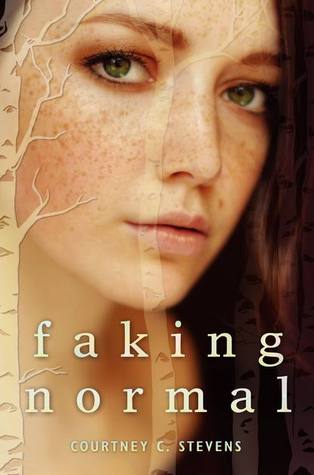
This month we're pleased to highlight debut YA novelist, Courtney Stevens and her novel, Faking Normal,an absolutely riveting book about a girl who must learn to cope with a secret she’s been hiding since summer, one she’s literally destroying herself over.

Marcy first learned about Courtney’s book journey from our good friend Kate Dopirak through an article she submitted to Marcy for the SCBWI newsletter. You can read that article here.

When we learned that Courtney’s book was out, Marcy and I couldn’t wait to read it. We were not disappointed. We hope you enjoy our answers and encourage you to buy the book.


1) What is your favorite line or paragraph from the novel as it relates to the main character's development and/or growth?

Dave – The section I chose comes from near the end of the book when Lexi, the main character, has emotionally come to grips with what has happened to her. She’s in the woods behind her house watching a bird and wondering why it hadn’t flown south for the winter. I believe this section contrasts well with what Marcy picked (see below), which comes from earlier in the novel.

This morning, for one second between my pain and the fear that Bodee would tell, I imagined what it would be like to be free.

That’s what Bodee is imagining for me, I think. What he wants for me.

Freedom.

The choice is mine, I realize. I can be the bird clinging to a windowsill in Tennessee when all my friends are in Florida, or I can be the bird who flies away.

I can be free.

I decided to keep my secret, and now, I decide to let it go.

Marcy – This paragraph captured the mental and physical pain of the main character Lexi. This part of the book really stood out for me as Lexi tries to cope with what has happened to her. One way she copes is by clawing the back of her neck with her nails.

Blood smears into the collar of my shirt. It’ll never go into the hamper for Mom to wash. “You let him. You let him.” God, I wish I could bleed him out of my life. If only I could make the outside hurt more than the inside.

To keep myself from scratching deeper, I push open the door a sliver and stare at my bedroom ceiling. My breath leaves me, and the numbers start automatically. The compulsion is overwhelming. I have to count.

One. Two. Three. Four. Five. Six. Seven. Eight. Nine.

Don’t Blink. My eyes start to burn.

Ten. Eleven. Twelve. Thirteen. Fourteen. Fifteen. I can’t blink. I’m almost there.

Sixteen. Seventeen. Eighteen. Nineteen.

Blink.

Dammit.

No matter. I’ll start over and try again to reach twenty-three.

Sometimes I stand on my bed and run my hand over the metal air-vent slits as if they’re a weird form of Braille. Those openings breathe cold air on me. Twenty-two holes of darkness. Twenty-three spaces of light. It’s hard to count them at night after they blur into a flat black hole.

Now I understand all the girls in my school who cut. I used to think of them as idiots who didn’t know how to cope. Now, I realize they are coping. Just not as well as I do.


2) What is your favorite chapter ending or cliffhanger?

Dave - My favorite cliffhanger once again came from late in the book when Lexi has made the decision to confront her attacker. She writes her feelings which is the step that comes before her being able to express them verbally. (And I believe I have avoided giving away any of the mistery.)

I won’t be sorry for this. You are not my BEST BUDDY, you are a selfish asshole, and I hate what you did to me!

Marcy – Bodee is an outcast in school. Now his mom was murdered by his dad and he’s living with Lexi’s family. Bodee can’t go into his house where his mom died and asks Lexi if she could go in for him. 

“I found the earring. And I got you these from the kitchen.” I hold out the five little boxes of Kool-Aid.

And Bodee smiles.

Really smiles. Teeth and all. (They’re straight.)

And even though I have thrown up, walked through a crime scene, and rooted through the remainder of Mrs. Lennox’s life, I smile too.


3) Who is your favorite secondary character and why?

Dave – All along, I was ready to say that Bodee was my favorite secondary character, for all the reasons Marcy mentions below. I even had a quote she listed as one of my favorite quotes. But the more I began reading, the more I began to think that Kayla, Lexi sister, is also quite a complex character, so I chose her as my favorite secondary character and have listed below a quote which made me change my mind. This one came about halfway through the book, and up until this point, the only side we’ve seen of Kayla is that she is a nasty, spoiled sister. They are talking about a rumor around the school that someone has been raped and Kayla is trying to convince Lexi to tell her friends that they should report the incident.

“I mean, to imagine this guy forcing himself on a girl. Like, what if that was you? That boy, any boy, lays one finger on you without you wanting it and I swear I’ll tear him apart. And after that, I’ll let Craig finish him off.”

“Kayla-“

“You think I’m a self-centered bitch right now, but you’re still my little sister. Nobody’s going to hurt you.”

Marcy –  Of course it has to be Bodee. He is such a complex character. From his Kool-Aid colored hair to the way he knows how to find exactly the right words to help Lexi and make her feel safe. He has lived a tough life and is extremely wise. These two incidents show Bodee’s true character. The first is when Lexi brings him to her fort. The second is at night when Lexi is trying to fall asleep and looks to her vent to count.

We reach the fort’s ladder in what feels like three steps. A spider has made a home in the space between the two bottom rungs. Bodee doesn’t disturb it, but instead takes a high step above the eight legs. I want to squash it, but I climb over the spider too, since he worked so hard to avoid it.

“Lex” – he looks over his shoulder at me as we climb through the opening to the highest level – “your secrets are showing.”

I am neither surprised nor horrified at the way he cuts right to the core. Maybe, in fact, I’m a little relieved. “I know. Weird day.”

And the second

The vent is gone.

A cover from Hatchet conceals the vent’s twenty-two lines and twenty-three spaces.

And I am smiling and wiping at sudden tears. Because he has stuck his one precious possession, using four pieces of tape, over the place I want to avoid.


4) What is your favorite line or paragraph of description?

Dave – There’s more than a few sections I had picked out for my favorite, but the ones that stood out to me most always focused on her counting the slats in the air vents in her room, because it’s details such as this that makes this story so real and so gripping… And so sad.

But he never looked at my face. I know because I never blinked. I can’t count the slits in the vent without blinking, but that night it was if my eyelids were wired open. I saw everything. Everything. His eyes were closed when it started, when he reached for me for comfort, and I froze. When he kissed me and I stayed silent. And his eyes were closed while he worked. Because he didn’t want to remember I wasn’t his girlfriend. He didn’t want to realize he was doing to me the things he wanted to do with her.

Marcy – This paragraph is so powerful, no other comment is necessary.

“You can’t buy him some new wardrobe or cut his hair and make it all happy. His mom’s dead. His dad killed her. No matter how badly you want it, there’s no magical cure that makes it go away. Sometimes life just sucks.”


5) What is your favorite line of dialogue?

Dave –  It’s the same line I listed above under my favorite secondary character. Kayla won me over when she showed her true feelings.

“I mean, to imagine this guy forcing himself on a girl. Like, what if that was you? That boy, any boy, lays one finger on you without you wanting it and I swear I’ll tear him apart. And after that, I’ll let Craig finish him off.”

“Kayla-“

“You think I’m a self-centered bitch right now, but you’re still my little sister. Nobody’s going to hurt you.”

Marcy –  Lexi’s friend Heather has come to terms in her own way that she will accept Bodee into their inner circle – under one condition:

“Okay, be friends with Bodee if you want. Just don’t go drinkin’ the Kool-Aid. If you know what I mean.”

To read more about Courtney Stevens debut YA novel Faking Normal please go to:

Monday, March 31, 2014

The Book Club Boom

Once upon a time, encounters with friends on the street would be followed by questions about family, health or work. Not any more.  The first question you're likely to hear nowadays is, "What's your book club reading?" Am I right?  Book Clubs are everywhere.  According to a New York Times article estimate, some five million people nationwide gather every few weeks in a living room or in a bar or bookstore or local library to discuss someone's book.  Though some groups distinguish between the host and the facilitator, a recent trend includes having the book's author present or skyped in to facilitate the discussion.  Though such a presence might quash some feedback, what better insight than from the source? And take note authors; a new source of income is now available.
There are virtual book clubs as well - ZolaBooks connects readers while Goodreads gives members the opportunity to read a book together.  Book Clubs also form along the lines of particular constituencies, be they gender, age, fans of a single author, or genre.
In the end, says James Atlas*, book groups are about community.  "The success of the One City, One Book initiatives in Chicago, Seattle and smaller towns...reflects the longing to share.  So does Oprah; her book club binds together a nation disparate in its customs, classes, religions and ethnicities by putting it in front of the TV and telling it what to read."
Reading is a solitary activity, but talking about reading? That's the connectivity of a Book Club.


*"Really? You're Not in a Book Club?" by James Atlas, NY Times, March 23, 2014

Submitted by Andrea Perry

Friday, March 28, 2014

Book Review Friday: Susan Cain's "Quiet: The Power of Introverts in a World That Can't Stop Talking"

By Carol Baicker-McKee

This one's for the grown-ups. (But don't worry, I'll add some picture book suggestions at the end.)

If you haven't already discovered Susan Cain's thoroughly researched (and influential) 2012 nonfiction book about introverts - individuals who prefer lower levels of stimulation - well, get thee to a library or bookstore! (The link above takes you to Cain's website where you can order copies - signed, even - of the book.) I for one regret waiting this long to read it myself.

What It's About
In Quiet, Cain explores the nature of introversion (which is not synonymous with shyness or fear of public speaking and also differs from autism) and extroversion. She sees this dimension of personality, which she identifies as "the North and South of Temperament," as being as fundamental to an individual's life as gender, affecting people's relationships, work, and sense of satisfaction, as well as influencing how easily they can make a mark on the world.

It took Cain seven years to research and write this book, which is easy to imagine even from the depth and breadth of her research in Part I on the history of how extroversion became the cultural  ideal in the U.S and much of the West and what the consequences, good and bad, have been for our society as a result. Her thorough and intriguing style continues throughout as she looks at introversion from many perspectives. Part Two examines the biology of introversion-extroversion; Part Three looks at Asian culture and its acceptance of introverts (many reviewers found this section most troubling); and finally, Part Four is a practical guide for living with your own temperament and interacting with those who differ. Throughout, Cain weaves clear explanations of scholarly research from a wide range of fields, interesting biographical anecdotes of historical and contemporary figures, personal revelations, and analyses of political, economic and news events. Although the book has had its share of negative reviews, I found it to be as readable and ground-breakingly analytical as anything by Malcolm Gladwell (author of influential bestsellers like The Tipping Point, Outliers, and David and Goliath), which is high praise from me.

If you'd like to learn more before committing to reading it, you can check out information on the book on Cain's website, watch her TED talk on introversion, read the Wikipedia entry about the book and its influence, or check out a wealth of reader reviews (and other resources) on Amazon here and Goodreads here.

Why Members of the Book Community Might Like to Read This Book
Sara Reading. Paper cut by Carol Baicker-McKee
For Self-Help/Validation
Based on her research, Cain estimates that between one-third and one-half of the world's population is introverted. Based on my personal experience, I'll estimate that the proportion of introverts among writers, illustrators, avid readers, librarians, and editors and many others in the publishing field is at least two-thirds. And that makes sense: as Cain discovered, creative work typically demands long periods of solitary, inner work - just the conditions under which introverts thrive. (Want a quick evaluation of where you fall on the introversion-extroversion spectrum? You can take Cain's informal quiz here). The information in Quiet will help us introverts understand our needs and tendencies better and help us cope better with extroverts and situations requiring a more extroverted style (think the marketing demands that are now integral to any book-related career). Perhaps even more importantly, Cain's book offers reassurance that not only are introverts okay, their style is essential for our society.

For Character Research
Books like Quiet are great for research in developing characters, particularly if those characters are different from you. Quiet not only offers a wealth of detail about how introverts think, behave and develop - it also provides behind-the-scenes portraits of extroverts, making it easier to create a convincing one (should they seem utterly foreign to you).

By  the way, I have my doctorate in clinical psychology, so I've long been a fan of books about human development and psychopathology -- if you haven't been, you might want to consider adding them to the stack by your bed as background character research. (Let me know if you'd be interested in a future post on more of my favorite psych-for-writers books.)

For the Book's Influence on Publishing?
I don't have any objective information that the book is changing children's publishing, but I do know that it has been hailed as influential in areas as diverse as college admissions and the design of office space and furniture - and over the last couple of years, I've been seeing a growing stream of picture books on the market that could only be described as, well, quiet. And this after years in which nearly every picture book writer I know accumulated stacks of rejections for manuscripts that editors liked but deemed "too quiet."

I know, the timing isn't really quite right, given how long it takes a picture book to go from acceptance to publication (let alone conception), but still..

Here are a couple of my favorite "quiet" picture books from recent years.

The title says it all (though in fairness, there's also a companion Noisy book). I especially love the softness and humor of Renata Liwska's illustrations for Deborah Underwood's spare but charming text. You can visit the illustrator's Quiet Blog for glimpses of more quiet works-in-progress and a peek at her life.


Elly Mackay is one of my new favorite illustrators, and only partly because she favors three-dimensional media like I do. All of her work is breathtaking as well as original - and quiet. She uses a unique technique she calls "paper theater" and which incorporates layered sets, watercolor cutouts, and theater-style lighting to create luminous award-winning pictures. You can visit her website and blog, theaterclouds, as well as buy prints of her work on Etsy.

So What Do You Think?
Have you read Quiet? What did you think?
Do you agree or disagree that introspection is undervalued? Is it a useful trait in today's society?
How does your own introversion/extroversion influence your work? Your reading choices?

Monday, March 24, 2014

The Art of Waiting by Judy Press

I'm often asked how I got started as a writer and my answer is that I literally "fell" into it. Twenty-two years ago I was teaching art part time when I slipped on black ice and shattered my femur. After two surgeries my family suggested that I put a few craft ideas for young children and teachers into a book. I titled my book, "The Icky Sticky Not-Too-Tricky Craft Book." That book was bought by Williamson Publishing, who promptly re-titled it, "The Little Hands Art Book." And so began my new career of writing and submitting and waiting and waiting and waiting to hear from publishers. In those "good" old days, I would anxiously await the mail carrier and the return of my SASE. Would there be a letter from an editor with high praise for my submission and a promise to publish it immediately? Or would it be a "nice" rejection where the editor scribbled a few kind words at the bottom of a form letter? That feeling of anxiety was like buying a lottery ticket and dreaming about becoming an instant millionaire. But times, along with the book business, have changed. No longer are SASE's required for most publishers and many request electronic submissions with a response  only if they're interested. Oh how I long for the feeling of my fate being sealed in a white envelope and slipped through my mail slot! So if you're among those of us who are anxiously awaiting a response to a submission, here are five fun things to do while you wait:
1. Read every book that was nominated for a Caldecott and Newbery award
2. Sign up as a volunteer reader at your local chapter of, "Reading Is FUNdamental" 
3. Donate the children's books your kids have outgrown
4. Pay a visit to your local library
5. Buy a lottery ticket (hey, you never know!)

Friday, March 21, 2014

Five on Friday - Five Picture Books that made me smile, and often laugh out loud

Scaredy Squirrel by Melanie Watt.
Scaredy Squirrel can't seem to stop being, well, Scaredy Squirrel.  In Scaredy's newest adventure, it is falling asleep and dreaming of scaredy things that has got his tail in a bunch.  Watt uses her usual format of first jumping into the specific anxiety-producing list which often includes those dreaded killer bees, and then proceeds with the plan to then avert the potential crisis.  In this case the ways to stay awake are 1) playing the cymbals, 2) scrapbooking, and 3) counting stars.  Does Scaredy stay awake? Does the strategy work? It is all very predictable, albeit hilarious.  However,  I have always loved that Scaredy is problem solver who approaches each situation by making a  specific plan, no matter how wacky. 
Sparky! by Jenny Offill and Chris Appelhans.
Sparky is the story of a sloth who arrives by Express Mail, the perfect pet for a little girl who is advised by her mother that the best pet is one that doesn't need to be "walked or bathed or fed."
Sleeping 16 hours a day is good for that.  But other pets, the little girl finds, have special talents.  Quickly she advertises a performance for Sparky to showcase the tricks she hopes to be able to teach her pet.  Will Sparky be able to do anything besides play possum? What exactly must a pet be able to do to be the perfect pet?  You might be surprised.

Superworm by Julia Donalson and Axel Scheffler
Meet Superworm, a creature of more talents than you might think.  Fellow creatures in this earthy homeland know that Superworm can become whatever the situation requires; a skipping rope, a fishing line, a lasso, a crane, a swing, or slide.  Superworm is ever so helpful to all.  Alas, Wizard Lizard has other plans.  He wants to harness Superworm to dig until he unearths some treasure, or else be eaten by a hungry hench-crow.  What will the forest critters do to save their friend from such a fate?
How to Train a Train by Jason Carter Eaton and John Rocco
I had planned on not liking How to Train a Train, but got derailed.  This delightful 'pet' training guide provides detailed steps on Train care. It is a comprehensive manual for catching, keeping, naming and training Trains.  Would you have any idea where to look for a Train in the wild? Would you be able to select an appropriate name, be it Milo or Smokey or Captain Foofamaloo?  Would you know how to make new friends for your Train, like airplanes, trucks or submarines? You will happily pass up a  Pomeranian after enjoying this tale of a companion from the other side of the track.
Sophie's Squash by Pat Zietlow Miller and Anne Wilsdorf
One day at the Farmer's Market, Sophie met a squash that she had to have. Sophie's parents were surprised to find that Sophie's plans for her little squash did not include brown sugar! Her new squash fit perfectly in her arms and in her life.  They snuggled, rolled down hills, read together and genuinely loved each others company.  However, after a while Sophie's squash began to look a little worse for wear, and so she took it back to the Farmer's Market to visit some friends.  The farmer gave Sophie some advice about just what her squash needed.  After lovingly covering her friend in some soft earth for some R&R (and a change of seasons), Sophie found come spring that her squash family had grown.  This little tale gives new meaning to loving your vegetables.

Submitted by Andrea Perry


Tuesday, March 18, 2014

Kate Greenaway, Tiffany Glass, Early KidLit - and Sunshine


Boy Holding Apple Pie, 1886
Illustration detail from A Apple Pie
Hand-colored woodblock print
Kate Greenaway, English, 1846-1901
Printer and engraver: Edmund Evans, British, 1826-1905


We just got back from Florida – a welcome trip after a hard winter. My daughter’s best friend from high school is doing an internship at Disney so we went to see her and to feel sunshine again. Maybe you’re making plans to take the kids to Orlando to visit the Mouse. If you are, here’s a special treat to include on your itinerary that doesn’t involve waiting in line for rides.

The Charles Hosmer Morse Museum of American Art, located just north of Orlando in Winter Park, houses an amazing collection of the works of Louis Comfort Tiffany , along with an impressive collection of American art pottery, American paintings, and the decorative arts.

And through January 11, it is also hosting an exhibit called “Lullaby and Goodnight – Children’s Literature from the Morse Collection”. Trust me, it’s worth begging your spouse to watch the kids solo for an afternoon while you take the rental car, hop on I4 heading north and immerse yourself in the beauty of this museum and this charming exhibition. The focus of one of the gallery rooms is on three early contributors to children’s books – Kate Greenaway, Mary Dow Brine, and Eulalie Osgood Grover. Displayed are precious early books, antique pottery tiles used as nursery décor, and vintage dolls. Here’s the reasoning of that time period:

“…children’s books were part of a broad social effort to instill an early appreciation of beauty and, in turn, improve the character of children.”

 
Enjoy the books, the stained glass, amazing art. And enjoy the sunshine.
Wishing you safe, happy travels that inspire you and your writing.


Monday, March 17, 2014

NYT on the Apartheid of Children's Literature; WaPo on Swoon Reads

by S. C. Poe

This week two mainstream newspapers discussed books for young readers. I found the contrasting coverage instructive. 

The Washington Post discussed a glut of books; the New York Times described a deficiency. 


Swooning for Romance 
The WaPo article covered the Swoon Reads website, on which Macmillan "allows anyone to submit a completed [YA romance] manuscript directly to its easy-to-use Web site" and makes the mss available for free to as many registered members as wish to . . . swoon.  

Swoon Reads functions as a combination slush pile and focus group, with the  membership community rating every book they read. (Macmillan is careful to make no promises, but top-rated books may be considered for print and e-book publication and sale. Indeed, one story will graduate onto the Macmillan print list this year, with a first publication run of 100,000 copies.) 

Swoon, of course, took advantage of a trend that had already gone viral: a vast network of readers who craved teen e-romances, and who had already developed ways to publicize the ones they liked best.  

The WaPo lede asked "What do [children's book] readers want?" Two days later, the New York Times offered two op eds that gave a sad answer: something nobody's publishing.  

The op eds were written by Walter Dean Myers (Newbery and Printz award-winning author of more than 50 books for young readers) and his son Christopher Myers (Caldecott and King-winning author and illustrator). 

Christopher Myers illustration for NYTimes

Both editorials referenced statistics published through recent years by the Cooperative Children's Book Center at the University of Wisconsin-Madison's School of Education. (Look here for their complete statistics for Children's Books By and About People of Color Published in the U.S.)

W.D.Myers'editorial focuses on this particular finding: out of an estimated 3,200 children's books published in 2013, only 93 were primarily about Africans or African-Americans. 

As the CCBC itself notes, whether considering books about African-Americans, American Indians, Asian or Asian-Pacific Americans, or Latinos, "The news in terms of sheer numbers continues to be discouraging: the total number of books about people of color—regardless of quality, regardless of accuracy or authenticity—was less than eight percent of the total number of titles we received. Think about that. Think about it terms of what you know about the changing demographics of our nation."

And if you check the CCBC's charts, you'll see that the number of African-American writers published in a given year is also low, and actually seems to be shrinking. The whole industry seems to be failing at discovering/developing new writers of color.   

The apartheid of children's literature


Christopher Myers writes that "too often today’s books remain blind to the everyday reality of thousands of children. Children of color remain outside the boundaries of imagination."

And W.D. Myers observes that even when a story's main character is black, he or she is often primarily a victim, "struggling to overcome either slavery or racism."

As a child reader, W. D. Myers could never seem to find his ordinary self—his life, his experience—in books. And all these years later, young readers of color still can't. 


Does the publishing industry even know how to publish for readers of color? 

Are editors cautious and reluctant, because they simply don't know what to publish? How many children's publishing editors and agents and marketing people can even claim to recognize the authentic "everyday reality" of children of color?

And is there really no market for these books? Or is the market simply untapped? 

Pondering this, I clicked back to the WaPo article. 


Using the Wisdom of Crowds to Pick the Next Teen Romance Bestseller

That's how the WaPo described the Swoon Reads approach. Macmillan senior vice president and publisher Jean Feiwel explains that her team created Swoon to discover new stories and let them find their market in a way that costs less in time and money. "Okay, I thought, there are authors out there . . . . I feel there’s a lot of talent out there that can’t get to us.”

Could the Swoon Reads concept be adapted to find new writers of color, and stories in which young readers of color can find themselves? 

True, Swoon hopped onto an already thriving romance-reading network. 

But could networks for other genres be grown from seed? Could major presses follow the Swoon model to discover and test-market other genres of books? 

Could today's young Walter Deans and Christophers learn to find themselves in ebooks?