Welcome!

Please join us to discuss everything literary (especially kid literary): good books, the writing life, the people and businesses who create books, controversies in book world, what's good to snack on while reading and writing, and anything else bookish. We welcome your thoughts.

Friday, May 15, 2015

Summer Boredom?

by Marcy Collier


As the weather gets warmer and school winds down, parents, children and teachers begin the countdown for the last day of school.

But I know after about a week off from school, I hear the familiar, “I’m bored,” from my children.
We make weekly trips to the library and participate in summer reading programs.

The American library association states, “Summer reading programs began in the 1890s as a way to encourage school children, particularly those in urban areas and not needed for farm work, to read during their summer vacation, use the library and develop the habit of reading. Libraries also now offer summer reading programs for adults, as well as children. Research conducted by the National Center for Educational Statistics found that in 1994, 95% of public libraries offered summer reading programs for children; there are not statistics for adult summer programs.”

That’s a fact I didn’t know, how about you?

All of our local libraries have reading programs as well as bookstores. Here’s the link to Barnes and Noble’s summer reading program:


We read and listen to a lot of books in the summer. Between the library and my audible subscription, we always have at least three audio books in the car for both short and long car rides and a half dozen books at home.

Besides reading, playing and swimming, I also have a few lists of ideas I’ll pull up when I hear the familiar, “I’m bored.” Here are a few links:


As the school year comes to an end, I hope that you all have a safe, enjoyable and not boring summer!

Wednesday, May 13, 2015

Finding something NEW in something OLD


A Listening Discovery

by Kitty Griffin


I've fallen in love with listening to stories. My new subscription to Audible is one of the nicest gifts I've given myself.

I listen while I drive.
I listen while I garden.
I listen while I work.

And sometimes I find something new in something old.

For instance, let me ask you about a story you've most likely read a long time ago or perhaps had read to you-- The Wind in the Willows. Of course you remember Mole. How he was doing spring cleaning and suddenly got a notion to flee from the work, to burst upon the outside. Feel the joy--

"The sunshine struck hot on his fur, soft breezes caressed his heated brow, and after the seclusion of the cellarage he had lived in so long the carol of happy birds fell on his dulled hearing almost like a shout. Jumping off all is four legs at once, in the joy of living and the delight of spring without its cleaning, he pursued his way across the meadow till he reached the hedge on the further side."

Yes, you know adventure is coming. And friendship, deep, enduring friendship, as the bond Mole forms with Ratty. 

It is the sort of friendship one dreams of. 

But now I'm going to ask you if you remember the environmental aspect of this book. Do you?

If I ask you, do you remember the quiet lesson that Badger taught Mole?

After being rescued from the Wild Wood by Ratty (who strapped on two six-shooters and carried a cudgel when he realized Mole had gone off) they find safety in Badger's hole. And what a place it is. Mole, so excited by the number of rooms and the beauty asks how Badger had time to do it all. Badger explains, he didn't. That once upon a time people had lived in the woods and had built a city, but the city fell to ruin.

Where did the people go? Badger didn't know.
Then what happened?

"When they went," continued the Badger, "the strong winds and persistent rains took the matter in hand, patiently, ceaselessly, year after year. Perhaps we badgers too, in our small way, helped a little--who knows? It was all down, down, down, gradually--ruin and leveling and disappearance. Then it was all up, up, up, gradually, as seeds grew to saplings, and saplings to forest trees, and brambles and fern came creeping in to help. Leaf-mould rose and obliterated, streams in their winter resets brought sand and soil to clog and cover, and in course of time our home was ready for us again, and we moved in.  Up above us, on the surface, the same thing happened. Animals arrived, like the look of the place, took up their quarters, settled down, spread and flourished. They didn't bother themselves about the past--they never do; they're too busy."

What do you think happened to the people?

I was so astonished when I heard this section.

But that's what listening can sometimes do, sometimes it will help you find a new nook, a new cranny. 

I will keep listening, but I don't think I'm going to find out what happened to the people. 
But I'm going to wonder, I'm going to wander through these Willows and feel the Wind and wonder what on earth happened to the people.

And when I finish listening?

I'm going to go buy this book for some young friends of mine so we can read it together.


Tuesday, May 12, 2015

Why I Love Fantasy

by Cynthia Light Brown

From the Master, J. R. R. Tolkien:

"When we have examined many of the elements commonly found embedded in fairy-stories … as relics of ancient customs once practiced in daily life…there remains still a point too often forgotten: that is the effect produced now by these old things in the stories as they are…They open a door on Other Time, and if we pass through, though only for a moment, we stand outside our own time, outside Time itself, maybe." (“On Fairy Stories”)

Even the words, "a door on Other Time" causes my breathing to alter. The encounter with the Other.

Perhaps this could be said of all fiction?

J. R. R. Tolkien's original illustrations for the first edition of The Hobbit, 1936. 


Friday, May 8, 2015

More Poetry Recipes in the Classroom: Add a Dash of Shape Poetry by Andrea Perry

Adding a dash of Shape Poetry is bound to spice up many a classroom project.  Get the point?

Shape poetry is a type of poetry which describes or defines an object (or concept, function or characteristic) and is shaped as the object (concept, etc) being described.  

For example, in math class students can demonstrate their knowledge of geometric shapes (even three dimensional ones!) by constructing a work of art.  They can show what they know.  They can type or write or stencil their words, rhyming or not, and arrange them to explain terminology.  Quadrangles, cylinders, squares, oh my!
 In Social Studies, similar projects can take shape. While studying Egypt, students can display their understanding of the mummification process or afterlife beliefs or even Egyptian gods by constructing a poem in the shape of a sarcophagus, linen strips, a pyramid or other related subject content. In an American History unit, Fort Necessity could necessarily be constructed with beams of words, the evolution of the American flag could be striped with information, or the Boston Tea Party,  steeped with facts.
Out in the solar system, scientists have described planets, galaxies, constellations, meteors, stars, and comets to us.  Students can make a big bang by applying their knowledge of any of these with a shape poem full of facts or descriptions.  The applications in science are seemingly endless - atoms and molecules, seeds and plants, magnets and metals can all take shape as shape poems.

Life does indeed imitate Art.  Get out the construction paper, scissors and glue and have your students start getting plenty of poetic projects "in shape."


Wednesday, May 6, 2015

Should You Judge a Book by its Cover?

A Book by its Cover


By Kitty Griffin


If you’ve got a moment go to Publisher’s Weekly BEA 2015 “Can’t-Miss Kids’ Galleys” where they’ve listed some of the promising children’s titles coming out this year.
(http://www.publishersweekly.com/pw/by-topic/industry-news/bea/article/66495-bea-2015-can-t-miss-kids-galleys.html)

The first thing I did-- scan through the covers. Which one….which one…catches my eye.

This one. Not just the artwork, but the title! I LOVE it. A Curious Tale of the In-Between. What a curious title. That one definitely draws me in. Okay, I’m perusing again. Seeking the next best one. Nothing too different, nothing too eye-catching until…ah, look at this, Orbiting Jupiter. Interesting art, a boy soaring…or is he?

The next one that says, LOOK is The Accident Season, the world has turned upside down with the ground on top and the sky below with a falling girl. Yes. Intriguing.

Now, let’s go back and read the blurb for each of these.


A Curious Tale of the in-Between by Lauren Defano, the author’s middle-grade debut, launching a series in which a girl can see ghosts.”

Yes. I will at least download a sample of this book to see if I want to keep going.


Orbiting Jupiter by Gary Schmidt, about 14-year-old Joseph, who joins his family as a foster child after leaving prison and seeks to find the daughter he’s never seen.”

Hmmm. The depth of the emotion in this one, it would have to have some darned good reviews before I’d take the time to even look at a sample.


“The Accident Season, the story of Cara and her family, who inexplicably and unavoidably become accident-prone every October.”

This could be interesting. Curious premise. Curious indeed. Yes. I’ll take a look.

Now, there were several covers that just didn’t do it for me. To begin with, I’m tired of the angst-filled face of a teen-age girl. These populate the YA shelves. So, here we go again.

A History of Glitter and Blood.

Okay, I’ll read the blurb. “A History of Glitter and Blood by Hannah Moskowitz, in which Beckan’s fairy clan is forced to venture into the gnome underworld to survive a war.

Oh Chronicle, that’s the best you could do for a cover? Seriously? Why not a divided picture with war on top and gnomes below? Because I LOVE fantasy. Sigh. What do you think?


Look at this cover for I Crawl Through It. I wouldn’t even pick this up to read the back matter. So let’s see—“I Crawl Through It by A.S. King about four teenagers coping with anxieties from senseless high-stakes testing and the lingering damage of past trauma”.

Huh? What is this about? Testing? Teenagers? Angst? The cover tells me nothing. The title tells me nothing. The blurb tells me nothing.

Am I being too harsh?


The final cover that just made me say, Huh? Was More Happy Than Not.

What did Zach say on the show “Bones” --- “What’s that mean?”

Let’s look at the blurb—“More Happy Than Not by Adam Silvera, in which 16-year-old Aaron Soto is coping with his father’s recent suicide.

Sorry. The cover doesn’t do it for me. The blurb doesn’t do it for me. The title doesn’t make me happy. Or not.


How important to you is the cover?
What about the title?

Don’t you wonder how they come up with these designs?

If you have a moment, I’d love to know which one appeals to you.


Monday, May 4, 2015

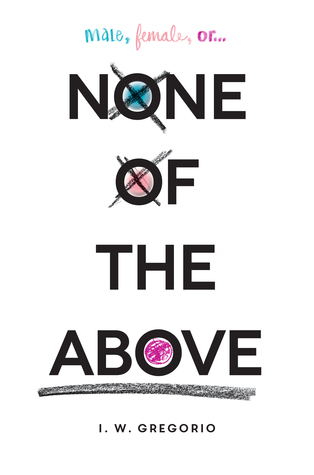
None of the Above

None of the Above

On Friday, May 1, 2015, Marcy and I shared our Five Favorite Things from I.W. Gregorio's debut novel None of the Above. We finished the book practically overnight and can't wait for you to read it. 

I.W. Gregorio is a mother, surgeon and wife as well as a founding member of We Need Diverse Books. So to say this author is busy is an understatement.

We will share her Five Favorites as soon as they are available.

Stay tuned.

In the meantime, to find out more about this fantastic debut author, please go to:


Friday, May 1, 2015

First Friday - Five Favorite Things - Debut Novel Day

None of the Above


by Dave Amaditz and
Marcy Collier


Welcome to May’s version of - First Friday - Five Favorite Things - Debut Novel Day. In this monthly series, we ask five simple questions about a debut novel that will hopefully entice anyone reading this post to pick up the novel and read it themselves, and/or give them at a glance some insight into the author's writing style and voice as well as how some of the characters might think or act. We do this by presenting, first, answers to our Five Favorite Things, followed by the author's answers in a follow-up post.

This month we're pleased to highlight debut novelists, I.W. Gregorio and her novel, None of the Above. Kristin is a senior in high school, homecoming Queen and track star, when she learns something about herself that makes her rethink everything about her she’s ever known. She’s intersex.

1) What is your favorite line or paragraph from the novel as it relates to the main character's development and/or growth?

Dave – Kristen has been wondering since her diagnosis who she really is. A daughter, a friend etc. etc. etc. She thinks back on something her track coach told her about hurdlers, as that is the event she participated in during track.

Hurdlers were a breed of their own.

When Coach Auerbach talked about the hurdles, she cautioned us that the event wasn’t for the faint of heart. “Hurdling has the steepest learning curve, and probably the most painful. It’s all about technique, so there’s a ton of practice involved. A lot of hitting your knees and face-planting. They say that hurdlers need three things: speed, flexibility, and courage.”

Within the first days of learning how to hurdle, I knew she was right to warn us. I looked at my sprinter friends and was totally jealous of how easy they seemed to have it. But at the same time, I loved being hard-core. That’s who I was: a hurdler. And hurdlers were never afraid to fall.

Marcy –  Kristin is trying to come to terms with her diagnosis and all of the emotions that come with it. She’s a runner and a hurdler. When she runs, she clears her head and is able to better deal with her problems.

You also tended to overthink less when it was close to freezing outside: Don’t look at a problem from so many angles that you lose sight of the real issue. Don’t worry about how your boyfriend will react  to your being a hermaphrodite, when you might never be ready to tell him what you really are.


2) What is your favorite chapter ending or cliffhanger?

Dave - There were so many great cliffhangers, but I chose this one because the depth of the betrayal from her boyfriend, Sam, and whoever it was that divulged her secret, was so completely devastating I felt I’d experienced it, too.

I collapsed against the lockers, and slid down into a crumple. Above me, people turned to stare as they hurried to class. I couldn’t see their faces through my tears, but I could feel the pounding and shuffling of their feet as they walked past.

The bell rang. The ground went silent. And I began to process how deeply I had been betrayed.

Marcy –  There were some terrific cliffhangers so like Dave, I had a difficult time choosing. Kristin seeing the gynecologist for the first time. When the doctor does her internal, she has a hard time telling Kristin her findings. Finally after she gathers herself, on the third try tells Kristin her discovery.

“Miss Lattimer, I think that you might be what some people  call a hermaphrodite.”


3) Who is your favorite secondary character and why?

Dave – I was torn between two, Dad and Darren, both strong and likable characters. In the end though I settled on Dad because of his inner strength which showed his true love for his daughter. Three lines of dialogue exemplify this, one from early in the novel when Kristen is first diagnosed and visits the doctor, one from later when Dad makes her breakfast like he used to do before her mother died and one from the end when Kristen had accepted her condition.

“What do you mean, you’ll look at her schedule?” My dad said, his voice growing louder. “This is an emergency.”

“Oh, just wanted to do something special for my girl.”

“You know I love you too, sweetie. Forever and ever, until the sun fades.”

Marcy –  Like Dave, I also had a hard time choosing, but decided on Darren because he is both funny and honest. I won’t give details since it will give too much away, but Darren’s offbeat sense of humor comes off nicely in this line:

“It’s not like I did anything but distract him. You delivered the knockout punch.” He let out a puff of a laugh. “Remind me to donate to a sperm bank before I ever pick a fight with you.”


4) What is your favorite line or paragraph of description?

Dave - This section, this image was so powerful I had to read again and again, each time I appreciated it more.

Most of the magazines were about golf and cars, and all the little brochures by the windowsill advertised Viagra and drugs for people who peed their pants. I stuck out like a sore thumb. One of the other patients, a man with white hair and brows so bushy they almost flopped over his eyes, kept looking up from his magazine in my direction. I wanted to say something to him about how it wasn’t nice to stare, but I knew it would draw more attention, so I tried to focus on the paperwork I was supposed to fill out. On the first line of the very first page it read:

NAME:                   SSN:                       DOB:                              SEX:

I stared at the posters on the walls, which were all colorful diagrams of kidneys and prostrates. Each of them had cross-sections of people cut in half - one male, with the penis sticking out like the mouth on the faucet. One female.

That’s when I realized that life was a multiple-choice test with two answers: male or female. And I was None of the Above.

Marcy – Great minds think alike. As Dave, the line (which is obviously the book title) stood out for me as well.

That’s when I realized that life was a multiple-choice test with two answers: male or female. And I was None of the Above.


5) What is your favorite line of dialogue?

Dave - This particular line of dialogue is spoken from Darren. He has unique perspective on Kristin’s diagnosis since his mother and father were divorced after his dad announced that he was gay.

“When he finally spoke, his voice was quiet but clear as glass. “If there’s one thing I learned from my dad leaving my mom, it’s that love isn’t a choice. You fall for the person, not their chromosomes.”

Marcy –  Kristin’s coach is a strong supporter of her and their team. Throughout the book, Kristin keeps her team’s mantra in mind and it becomes a reoccurring theme in the novel.

“Pain is weakness leaving the body.”

And then of course this line of dialogue made me laugh out loud with the visualization.

“Yeah, I was telling Kristin that my sister thought you danced like a Muppet on crystal meth.”


I. W. Gregorio is a practicing surgeon by day, masked avenging YA writer by night. After getting her MD, she did her residency at Stanford, where she met the intersex patient who inspired her debut novel, None of the Above (Balzer + Bray / HarperCollins). She is a founding member of We Need Diverse Books™ and serves as its VP of Development. Her writing has appeared in The Washington Post, San Francisco Chronicle, San Jose Mercury News and Journal of General Internal Medicine. A recovering ice hockey player, she lives in Pennsylvania with her husband and two children.

To read more about I.W. Gregorio’s None of the Above debut novel please go to: