Welcome!

Please join us to discuss everything literary (especially kid literary): good books, the writing life, the people and businesses who create books, controversies in book world, what's good to snack on while reading and writing, and anything else bookish. We welcome your thoughts.
Showing posts with label susan chapek. Show all posts

Friday, September 26, 2014

Durham Reads Together 2014 -- MARCH: BOOK ONE


By Susan Chapek

Every two years, the Durham (North Carolina) County Library sponsors Durham Reads Together. Its slogan: One Month, One Book, One Community.

This October, Durham will read and celebrate the graphic novel MARCH: BOOK ONE.


In 1958, a comic book ("Martin Luther King and the Montgomery Story") inspired John Lewis, an Alabama sharecropper's son, to make his own commitment to civil rights through nonviolent activism. 


Now Congressman John Lewis tells his own remarkable story through the same dramatic medium, collaborating with writer Andrew Aydin and popular graphic novelist/artist Nate Powell. Read more about the book here.


During the month of October, Durham Reads Together will stage a remarkable series of discussions, films and art showings related to the American evolution story told in MARCH.

From the Durham County Library web site: Durham Reads Together strengthens the community through a biennial celebration of reading. Reading the same book, and attending programs around its theme, inspires the Durham community to discuss important issues, including race, family, identity, faith, education, culture, music and visual art.

(In previous DRT programs, the community has read memoirs by James McBride and Dr. Paul Austin, narrative nonfiction by Darcy Frey, and fiction by popular North Carolina novelist Margaret Maron.)

MARCH: BOOK ONE is the first volume of a graphic trilogy. BOOK TWO is on pre-order and will be available early in 2015.


Friday, August 29, 2014

Poll: Most Memorable Meals in Children's Literature

By Susan Chapek

Inspiration for this poll:


In the delicious FICTITIOUS DISHES, photographer Dinah Fried highlights a wide range of notable literary meals—from HEIDI's comforting toasted cheese to THE BELL JAR's poisonous crabmeat-stuffed avocado

So what would the Route 19 Writers put into our own collection of Memorable Meals?


Our resident poet Andrea nominates Maurice Sendak's classic CHICKEN SOUP WITH RICE, "due to the combination of the soup as comfort food, and the lovely repetition at the end of each month's poem."

Happy once
Happy twice
Happy chicken soup 
with rice.


Kitty, who not only writes but teaches children's literature and writing for children, was struck by the way Naomi Shihab Nye  (HABIBI) gives small details, "things that are familiar and things that are just a bit different, that help young readers take in different cultures without being given a lecture.”

The owner, a nice man about Poppy’s age, brought them steaming bowls of aromatic lentil soup, saying once they tasted it, they would keep coming back for more. The table filled up with olives, purple marinated turnips, plates of baba ghanouj and hummus, and hot flat breads, even before the real lunch came.”


Devoted to historicals and classics, SCPoe admires how Charles Dickens could make a three-act drama out of one dish: 

. . . Mrs. Cratchit left the room alone—too nervous to bear witnesses—to take the pudding up and bring it in.
Suppose it should not be done enough! Suppose it should break in turning out! Suppose somebody should have got over the wall of the back-yard, and stolen it, while they were merry with the goose—a supposition at which the two young Cratchits became livid! All sorts of horrors were supposed.
Hallo! A great deal of steam! The pudding was out of the copper. A smell like a washing-day! That was the cloth. A smell like an eating-house and a pastrycook’s next door to each other, with a laundress’s next door to that! That was the pudding! In half a minute Mrs. Cratchit entered—flushed, but smiling proudly—with the pudding, like a speckled cannon-ball, so hard and firm, blazing in half of half-a-quartern of ignited brandy, and bedight with Christmas holly stuck into the top.
Oh, a wonderful pudding! Bob Cratchit said, and calmly too, that he regarded it as the greatest success achieved by Mrs. Cratchit since their marriage. 


For Dave,who's been concentrating on serious contemporary YAs, scenes of food deprivation can prove even more memorable than scenes of feasting. Out of several finalists, he finally chose a scene from Jerry Spinelli's MILKWEED.  

"It is early in the novel and the main character (Misha), known at this time by the name Stopthief, because he is always trying to steal food to feed his hunger, is brought into a barn where there is a large group of homeless,Jewish boys. They are so happy because they have been able to raid some of the finer German stores. . . . They have the food stacked in large piles in the corner of the barn. Sausages. Buns. Bread. Fresh fruit. They ask him if he is a Jew. He doesn't know what that is. So one of the boys in the barn explains what a Jew is. (The description is unbelievably scary and powerful.)"


In contrast, Marcy (Dave's partner in our monthly reviews of exciting YA debuts) chooses THE HUNGER GAMES, a series replete with scores of gourmet dishes. Nevertheless, Marcy zeroes in on something simple and familiar--a time when Katniss can't sleep and seeks comfort in a mug of warm milk and honey. 


YA writer Jenny would love to chow down at "any and all meals served in the Hogwarts Dining Hall from the Harry Potter books, especially the beginning of the year kick-off dinners."

He had never seen so many things he liked to eat on one table: roast beef, roast chicken, pork chops and lamb chops, sausages, bacon and steak, boiled potatoes, roast potatoes, fries, Yorkshire pudding, peas, carrots, gravy, ketchup, and, for some strange reason, peppermint humbugs.


My own nominee comes from Louisa May Alcott's JACK AND JILL. Sensitive, artistic Merry feels out of place in her drab farmhouse surroundings. In a coming-of-age episode, she longs to experiment with fancy pastry, but what her father wants is plain old corned beef and cabbage:  

She was repaid at noon by the relish with which he enjoyed his dinner, for Merry tried to make even a boiled dish pretty by arranging the beets, carrots, turnips, and potatoes in contrasting colors, with the beef hidden under the cabbage leaves.

I still think of Merry whenever I make a boiled dinner, and I admit that the smell of simmering cabbage (loathed by many) is a comfort to me. 


We invite you to nominate your own favorite to our potluck of Memorable Meals in Children's Literature.

Tuesday, July 29, 2014

Audiobook reviews: 5-star MG novels for family listening

by Susan Chapek


Today I'll piggyback on the recent post in which Kitty Griffin suggests two "musts" for selecting audiobooks.

The audiobooks on this list meet both of her criteria, and I found them all on my neighborhood library shelf. 

I'd recommend any of them for a family car trip with middle graders as the youngest passengers. I chose novels I consider new classics—honored books that some kids might postpone reading on the page ("too serious; too long; too literary"). But for a read-aloud? They're the audio equivalent of page-turners. And that would go for most adult listeners, too. 

I list them in order of original print edition publication date.

The versions I recommend are performed by narrators on my personal 5-star list. 


Roll of Thunder, Hear My Cry (Mildred Taylor; Random House/Listening Library edition narrated by Lynne Thigpen) 


The Westing Game (Ellen Raskin; Recorded Books edition narrated by Jeff Woodman) 


The Watsons Go to Birmingham—1963 (Christopher Paul Curtis; Random House/Listening Library edition narrated by LeVar Burton) 


When You Reach Me (Rebecca Stead; Random House/Listening Library edition narrated by Cynthia Holloway)

Friday, May 23, 2014

The Family Book Club reads about Mary Anning, the dinosaur hunter

by Susan Chapek


May 21, 1799 was the birth date of Mary Anning, daughter of a sea-coast carpenter who became famous for discovering (and studying) Jurassic fossils in the cliffs around her home town of Lyme Regis, England. 

Factual and fictional accounts of Anning's life and work have been targeted to all ages of readers, and are readily found in libraries. What if you gathered a selection of books--one or more suitable for each member of the family--and planned a family activity evening around Mary Anning and her fossils? 

Family Book Club meetings can include read-alouds, discussions, research, learning to sing or play appropriate music, related craft activities--even a special meal or snack (to celebrate Mary Anning, I suggest tea and rock buns).  

Here's a read-aloud version of her adventures that will delight the youngest dinosaur fans:


Stone Girl Bone Girl, 
The Story of Mary Anning
Laurence Anholt (Illustrations by Sheila Moxley)
Scholastic, 1999


Or choose these slightly more challenging picture books:


The Fossil Girl
Catherine Brighton
Frances Lincoln Children's Books, 2007

Mary Anning and the Sea Dragon
Jeannine Atkins (Illustrations by Michael Dooling)
Farrar, Straus and Giroux, 1999


Questions are sure to come up! You'll find answers in this bio for adults:


Jurassic Mary 
(Mary Anning and the Primeval Monsters)
Patricia Pierce
The History Press, 2006


Or you and your middle-grade children may prefer to read and discuss this "lighter" bio:  


Curious Bones: Mary Anning and the Birth of Paleontology
Thomas W. Goodhue
Morgan Reynolds, 2002


Meanwhile, parents can enjoy this version of Mary Anning's adventures, as imagined by the author of Girl With a Pearl Earring:


Remarkable Creatures (A Novel) 
Tracy Chevalier
Dutton, 2010


*          *          *          *         *         *         *         *          *

Another post you may enjoy:


Wednesday, April 16, 2014

New Rule for Writers: Butt OUT of Chair!


"Butt in chair. There is no other 
single thing that will help you more 
to become a writer."  Jane Yolen


Contradict Jane Yolen? Wouldn't dream of it!

But I would amend her.

Recent medical studies have found that prolonged sitting is a serious health risk factor--even if you also get regular exercise. The Mayo Clinic summarizes it here.  

As you age, the risks increase. Researchers found that after 60, "every additional hour a day you spend sitting is linked to doubling the risk of being disabled--regardless of how much moderate exercise you get...."

The boildown for writers? Get used to working with your butt out of that chair!

We have some famous exemplars:

Sir Walter Scott composed Marmion while galloping the braes on horseback. (That's one expensive office chair.)

And Edith Sitwell reclined to write . . . in a cushioned coffin. (The only possible objection to that might be the awkwardness of balancing a laptop on your midsection.)


More realistically, we can emulate Hemingway and Nabokov. They wrote at standing desks. (And don't worry about "losing your voice." Standing may have contributed to Hemingway's famous concision, but it had no such effect on the word-loving Russian.) 

The illustration at right shows recommended monitor and typing angles for standing work. Desk measurements will differ according to individual height and proportions, so--  

--for more precise ergonomics (and shopping and construction suggestions) consult sources like Bob Vila (6 DIY Standing Desk Projects) or lifehacker

Or seek inspiration here or here


CAVEAT: As any waitress can tell you, working on your feet all day carries its own risks. It can contribute to the development of varicose veins or hardening of the arteries.

A preliminary study among younger, healthy males showed the benefit of consciously varying one's work posture at specific intervals. It's not clear yet whether these benefits extend to workers of all ages, or to those with pre-existing health conditions. But Dear Boy was already inspired to devise this dual-position desk. It requires two monitors and two keyboards, but only one computer: 


My own solution is still a WIP. I'll report in a future post. 

Meanwhile, what's your . . . um, position . . . on this issue?

Susan Chapek

Monday, January 27, 2014

All About You--Ten Highlights Foundation Writer Retreats for 2014

A Ten for Tuesday Post

by Susan Chapek


Conferences are invigorating, inspiring, occasionally career-changing. Above all, they are sociable. But sometimes a writer needs more—stretches of uninterrupted time to give that special manuscript the attention it deserves. 


Sometimes it needs to be all about you. 


Highlights Foundation workshops offer both the guidance and fellowship of a conference . . .


and the privacy and concentrated writing-time of a retreat . . .


with meals, snacks, wifi, printer, jogging trails, beautiful vistas, and even morning yoga classes close at hand. (Look here for more details about what the programs offer.) 


Highlights will host more than three dozen workshops in 2014. The Highlights site lists them in calender order, so here I'll group them in interest categories:
  1. For every writer: Unworkshopsoffered eight times between January and November; you choose the number of days you need; $99 / day gets you all the benefits of your own private writer's cave (with food and fellowship close at hand). 
  2. Or choose a Guided Retreat with Jillian Sullivan or delve into Everything You [personally] Ever Wanted to Know with Donna Jo Napoli,  Eileen Spinelli, and Jerry Spinelli.
  3. Early readers: Writing from the Heart
  4. Educational/Nonfiction:
    Writing about Science;Writing About Nature; A Concentrated Course in Nonfiction; The Craft of Writing
    Short Nonfiction; Writing for the Educational Market;Writing for Magazines.
  5. Picture Books: Super Children's [Picture] Book Boot Camp; Picture Books and All That Jazz.
  6. Religious/Inspirational: Writing for Religious and Inspirational Markets; Writing Jewish-Themed Children's Books.
  7. Novels: Whole Novel Workshop in Fantasy & Speculative Fiction; Breathing Life into Minor Characters and Transition Scenes; The Plot Thickens; Writing the Historical Novel; Building a Novel from Sentence to Scene.
  8. Poetry: Rhymes with Reason; Poetry for the Delight of It; Autumn Poetry retreat & workshop.
  9. Experienced/published/returning writers may qualify for a Master Class with Patti Gauch or Carolyn Yoder; or explore Opportunities After Publication.
  10. Conferences and collaborations: Chautauqua East; or an E-book/Interactive Media retreat (with Dust or Magic); or one of two Power of Picture Books (with the Eric Carle Museum).

Wednesday, December 4, 2013

Today is National Cookie Day!


Observe this important day by making at least one batch for your Christmas Cookie Table.

Join the Route 19 Writers as we browse and bake some of our own favorite recipes.

The Pittsburgh Cookie Table baking blogs here on Route 19 present a great selection. (Each recipe comes with hints for tasty reading or writing, too!)


If you have a taste for the classics, allow us to suggest our: 

Fruit-cake bars
Spritz


Craving something new and different? Try


Butter fudge fingers


Auntie Mary Fudge Slices
Chocolate might be the flavor you favor:


Feeling nutty? Go for these super-easy


You can spice things up with the grown-up flavors of


Or revel in ethnic favorites like

Cream cheese kolache


  • Aunt Lee's Biscotti
  • Cream Cheese Kolache
  • Grandma's Pizzelles
  • Spritz
  • Yugoslavian Kifle   
  •       
       

    Yugoslavian kifle


    Grandma's pizzelles


    Russian tea cakes
                                         
    Easy, merry, and familiar—you can never get 
    enough of these
    family favorites:
         
    Rum balls


    Every good wish for your happy holidays from Susan Chapek and all the Route 19 Writers.

    Wednesday, May 30, 2012

    2012 Memorial Day Puzzle for Kidlit Lovers


    I love anagrams (words or phrases that can be rearranged to form other words or phrases). The anagrams below all relate to a single, memorable kidlit personage.

    Can you rearrange the letters in each entry to reveal the original list? (If  you can, you may brag in a comment, but please don't post any spoilers--I'll publish the solution next week.)


    Rave, Fay Wray!

    Dishearten wheelwright

    Giggly, gloppy epithet

    Thickening the thin

    Slow, supple me

    Outhit, Rose veered

    My blue bard


    (Need a hint? The subject of this puzzle used nice karma.)

    [Solution: I don't want to post an outright spoiler, but you'll find all the answers here.]

    Friday, December 16, 2011

    Hand-Me-Down Cookie Recipes

    or, The Pittsburgh Cookie Table--Christmas Style, part 6
    We've been talking about favorite picture books. This was mine.
    You may be more familiar with the iconic red and white folk art cover of earlier and later editions, but Mom owned the version published in 1956. I discovered Betty Crocker soon after I learned to read. She offered much more than lists of ingredients and procedures. Every recipe came with an anecdote, a bit of cooking lore or tidbit of celebrity gossip ("Christian Dior. . .sent us this recipe as a special favorite.") Charming, tiny illustrations accompanied these little stories.
    Later in life, Mom haunted used book stores all over the country, searching for copies so that each of her four daughters could own the same edition. She succeeded—no easy task, for people cling to these cookbooks. Five years ago, my dear sisters presented me with Mom's own marked-up copy.
    As a girl, I read the book so many times I can still quote bits. (Won't you come into our kitchen and join us in our "Cooky Shines?") I can still lose myself in its steam-stiffened, stained pages.
    If you haven't the luck to own a handed-down copy, the original 1950 edition is available in a 1998 facsimile. (Warning: only the 1956 version contains the Eskimo Igloo Cake instructions!)
    One indispensable component of any Christmas Cookie Table is found on page 220:


    RUSSIAN TEACAKES


    These scrumptious snowballs melt in the mouth. They'll also crumble into powder if you're rough with them before they cool. So treat them tenderly, and bake lots. (They freeze well.)

    MIX THOROUGHLY
    • 1 cup soft butter
    • ½ cup sifted confectioners' sugar
    • 1 tsp. vanilla
    SIFT TOGETHER AND STIR IN
    • 2 ¼ cups sifted flour
    • ¼ tsp. salt
    MIX IN ¾ cups finely chopped nuts
    Chill dough. Roll into 1" balls. Place on ungreased baking sheet (cookies do not spread). Bake [at 400 or moderately hot oven for 10 to 12 minutes or] until set, but not brown. While still warm, roll in confectioners' sugar. Cool. Roll in sugar again.
    Makes about 4 dozen 1" cookies.

    LIFE'S LESSONS LEARNED: I'd never try to mail or ship Russian Teacakes. But I've learned how to carry them safely on planes and trains. Nest one in each hollow of those hard, clear plastic boxes in which are sold a certain kind of popular round, gold-foil-covered chocolates. (You will have to find a way to dispose of the chocolates, first.)

    Since I'm reminiscing about hand-me-downs and family traditions, I'll share two Eastern European cookies my family always makes:


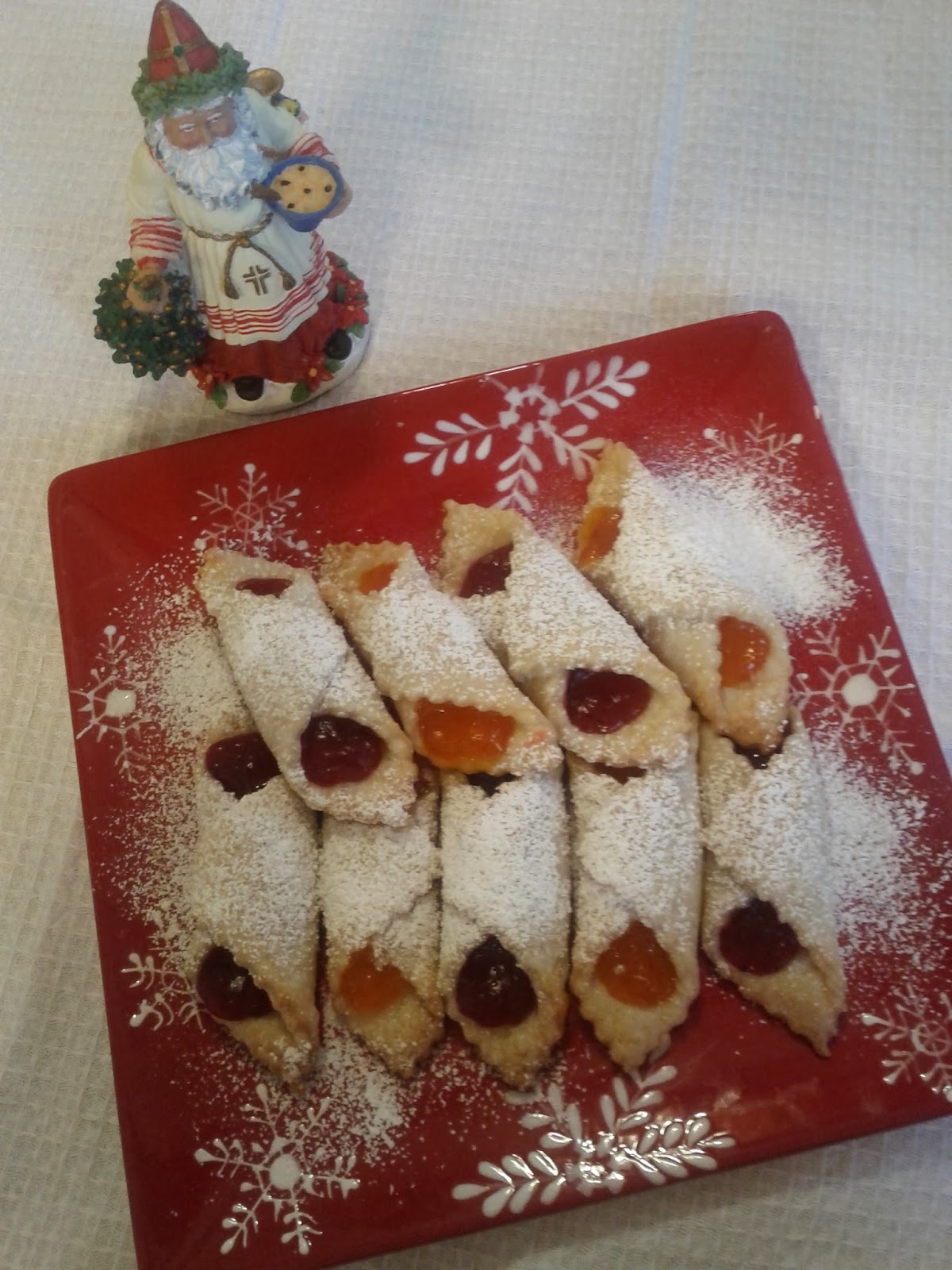
    CREAM CHEESE KOLACHE


    Kolache (or kolacky) means, simply, "cookies." There are lots of versions—Polish, Slovak, Czech, and so on. We pronounce it cuh-lotch-key, and we bake two varieties. This first kind is a two-bite treat, not too rich, and it freezes beautifully. (The other is more of a breakfast pastry, larger and with a yeast dough, and we wait to bake it until Christmas Eve.)
    • ½ pound cream cheese
    • ½ pound unsalted butter
    • 3 cups flour
    Begin with ingredients at room temperature. Cream the butter and cream cheese together. Then stir in the flour. Do not over-mix. Form into four flat, rectangular portions, wrap well, and chill overnight.
    Roll out on well-floured board until so thin it's almost translucent. Cut into 3" X 3" squares. Drop about 1 teaspoon of fruit filling in centers. Overlap two corners of each square in the center, moistening the dough with water to seal. (The dough resists sealing; be firm.) Arrange kolache about 1" apart on ungreased pans (we like the air-filled, non-burning kind) and bake until tops start to turn golden brown (up to 15 minutes) at 375.
    Just before serving, sieve confectioners' sugar on top.

    LIFE'S LESSONS LEARNED: Never, never, never fill your kolache with the commercial fruit fillings sold in 10 oz. jars. The filling will run out of your pastry and bake into fruit leather.
    So what to use? Best is to make from-scratch fillings, simmering 1 pound of dried fruit and 1 cup of sugar in 2 cups of water until the goo is too thick to drip off your spoon.
    But we're lucky enough to bake our kolache in Pittsburgh, where grocery store bake shops cater to home bakers by selling commercial fruit fillings in bulk.


    YUGOSLAVIAN KIFLE


    That's an outdated name, of course. I believe the recipe was Croation to begin with. These are fussy to make, and your grocery bake shop sells something that looks similar. Trust me, there's no comparison; these are super-flaky, and the filling has a delicate meringue crunch.
    • 2 cups flour
    • ½ cup unsalted, chilled butter
    • 1 egg yolk
    • 1 cup sour cream
    Make as for pie dough: in a food processor, pulse flour and butter together until it resembles coarse meal, with bits of butter still visible throughout. Add egg yolk and sour cream, and pulse just until a sticky dough forms. (Or you can make this pastry the traditional way, using a pastry cutter.) Shape into four flat rounds, and chill for one hour.
    After 45 minutes, prepare the filling:
    • 2 egg whites (reserve the extra egg yolk for the egg wash)
    • 1 dash cream of tartar
    • ½ cup sugar
    • 1 tsp. vanilla
    • 1 cup finely chopped walnuts
    Add cream of tartar to egg whites and beat until soft peaks form. Beat in the sugar until meringue-stiff and sugar is dissolved. Fold in the vanilla and walnuts.
    Remove one portion of dough from chiller. Roll into an 8-9" circle on a well-floured board. Gently brush with melted, unsalted butter. (Dough is delicate!) Cut circle into 16 pie slices. Put ½ teaspoon of nut filling on each wide end. Roll up and place on ungreased cookie sheet (we use the air-filled, non-burning kind). Gently brush with egg wash (1 yolk whisked with about 1 tbsp. water). Bake until golden, 20-25 minutes at 375. Cool on pan for 2-3 minutes. Remove cookies to rack while still warm, or they'll glue themselves to the pan.
    It's traditional to dust with confectioners' sugar before serving.

    LIFE'S LESSONS LEARNED: Some of my sisters recommend rolling and shaping the Kifle right on the cookie sheet; and instead of brushing with melted butter, they spread the dough thinly with softened, whipped butter. All of us agree that a rolling pastry cutter works best for dividing the dough; a knife tends to drag and distort it.